Félix Bonfils (1831–1885) was one of the most prolific photographers of 19th century Palestine. Born in Saint-Hippolyte-du-Fort in southern France, he joined General d’Hautpoul’s expedition to the Levant in 1860 and was so captivated by the region that he returned permanently, moving with his family to Beirut in 1867 where they established the celebrated “Maison Bonfils” photographic studio.
Over the following decades, Bonfils and his family produced thousands of photographs across Palestine, Syria and Egypt — documenting cities, holy sites, markets and landscapes that were largely unknown to Western audiences. His images were distributed as prints and albums across Europe and America, giving millions their first visual encounter with the Holy Land.
A Gate of East and West
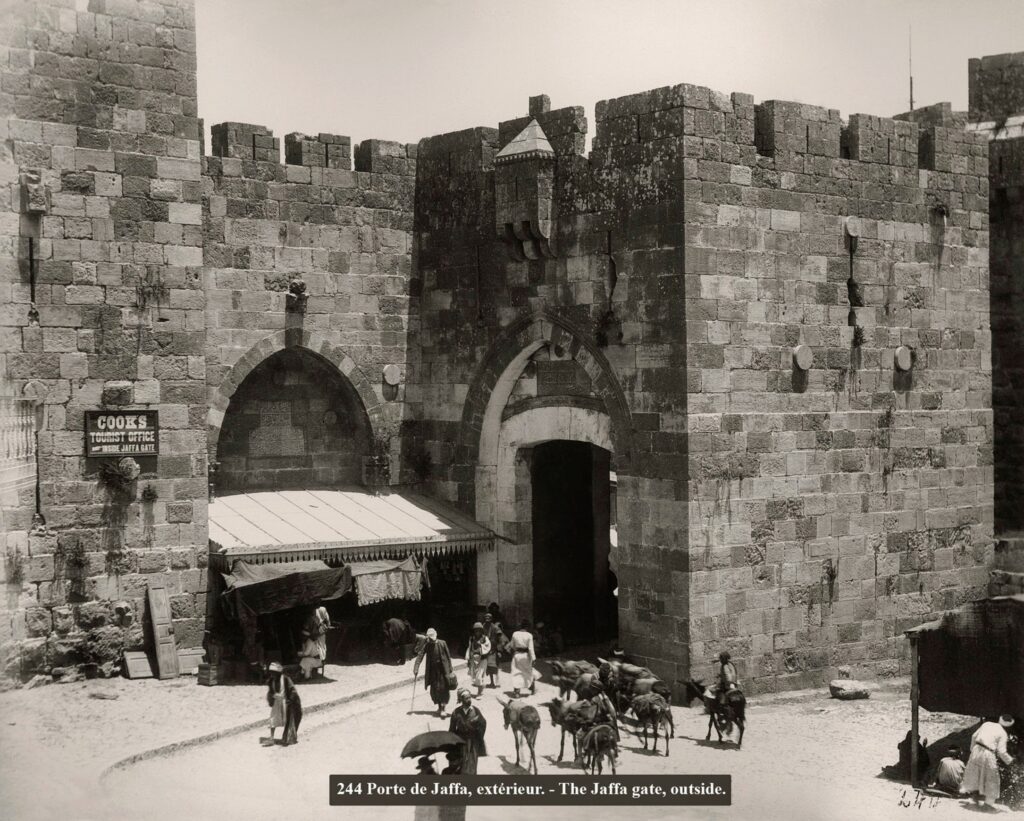
The gate in this picture is known in Arabic as Bab al-Khalil, the Gate of Abraham. In English, it is called the Jaffa Gate. It is the only entrance to Jerusalem’s Old City from the west, and it was the stage for two famous encounters between East and West. In 1917, the British general Edmund Allenby crossed this threshold on foot as a victor over the Ottoman Empire. In 1898, a gap was made in the wall next to the gate so that the German Kaiser Wilhelm II — a guest of the Ottomans — could enter Jerusalem on horseback.
The picture was taken even earlier — in the 1870s, 20 to 30 years before the Kaiser’s arrival. But already we can see this gate is an important spot for visitors from faraway lands. To its left is a sign in English that reads “Cook’s Tourist Office, inside Jaffa Gate”. Cook is the now world-famous Thomas Cook, who with his son John Mason Cook began taking European and American tourists to Palestine in 1869. Photographs like this one, taken by the Frenchman Felix Bonfils, were at least partly responsible for bringing them to the Holy Land. (Maher Mughrabi)
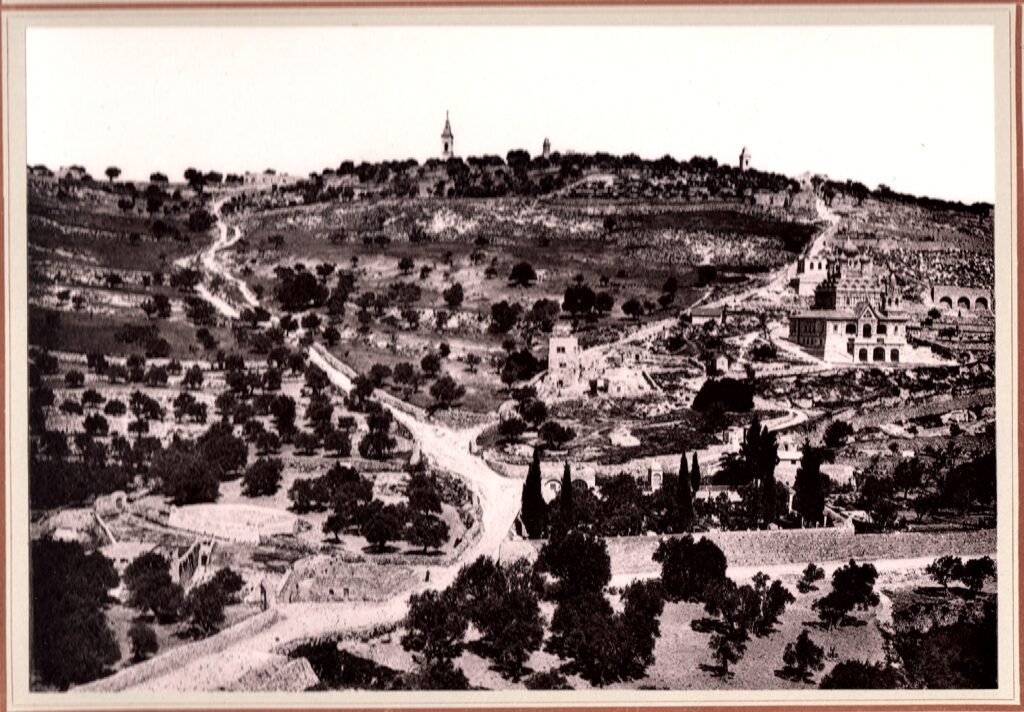
Wide Open Country
From the late 18th century onwards, the idea of travelling through the “wild” landscape for its own beauty began to take hold in Western culture and was reflected in art in what became known as the “picturesque” style.
An attitude to landscape that began with painters and poets was soon transferred to the earliest photographers. With the picturesque style, the evidence of human life — people and buildings — became less important to composition. Instead, the wider landscape was invested with emotional and even spiritual significance. Nowhere was this more true than in Palestine, where photographers turned away from the rapidly growing cities and towns of the 1870s and 1880s to focus on scenes of the Mount of Olives and Garden of Gethsemane, where many Christians believe the Transfiguration of Christ took place.
For a pioneer of photography like Bonfils, these landscapes would have been easier than crowded street scenes for another reason. The method he used, though the latest technology in its time, would still have required a lengthy exposure time by our modern standards, ruling out spontaneous images. As a binding agent on the paper, Bonfils used albumen, or eggwhite, which he and his family prepared themselves. Indeed, long after her husband’s death in 1885, Felix Bonfils’ wife Lydie forbade eggs at her breakfast table, saying that she “never want(ed) to smell another egg again”. (Maher Mughrabi)