
The Palestine Currency Board banknotes are among the most historically significant and beautiful currency ever issued in the Middle East. Established by the British Mandatory government in 1927, the Palestine Currency Board produced a series of notes that are remarkable on every level — for their design, their trilingual inscriptions, and for what they represent: the only currency ever to bear the name Palestine as an official sovereign designation.
The Palestine Currency Board
The Board was established in London in June 1926 under the chairmanship of Sir Percy Ezechiel, whose signature appears on every single note ever issued — from the first 500 mils in 1927 to the final issue of 1945. The notes were designed and printed by Thomas de la Rue & Company of London, the world’s most prestigious security printer. The League of Nations Mandate required that the name Palestine appear in all three official languages — English, Arabic and Hebrew — and the British administration went one step further, printing all text on every note in all three languages. The choice of buildings for the note vignettes was equally deliberate: each site selected for its significance to the three faiths that had shaped Palestine across the centuries.
These notes circulated in Palestinian markets, homes and businesses from 1927 to 1948. They are among the most historically significant — and most beautifully designed — banknotes ever produced for any country in the world.
The Palestine Pound — A Trilingual Currency
What makes Palestine Currency Board banknotes extraordinary is their design. Every note carried text in three languages — Arabic, English and Hebrew — reflecting the complex demographic and political reality of Mandatory Palestine. The Arabic text reads فلسطين (Filastin), the English reads Palestine, and the Hebrew reads פלשתינה (Palestina) followed by א”י (Eretz Israel). This trilingual formula was mandated by the League of Nations, which required Britain to recognise the three official languages of the territory. The result is a banknote unlike any other in the world — a document that encodes, in its very design, the contested identity of a land and its people.
The Collection — Palestine Currency Board Banknotes
The collection includes examples of Palestine Currency Board banknotes across multiple denominations and series — from the elegant first series of 1927 through to the final issues of the 1940s. Each note is presented here as a historical document — evidence of a Palestine that existed, that had its own currency, its own administration and its own people, long before the questions that surround it today.
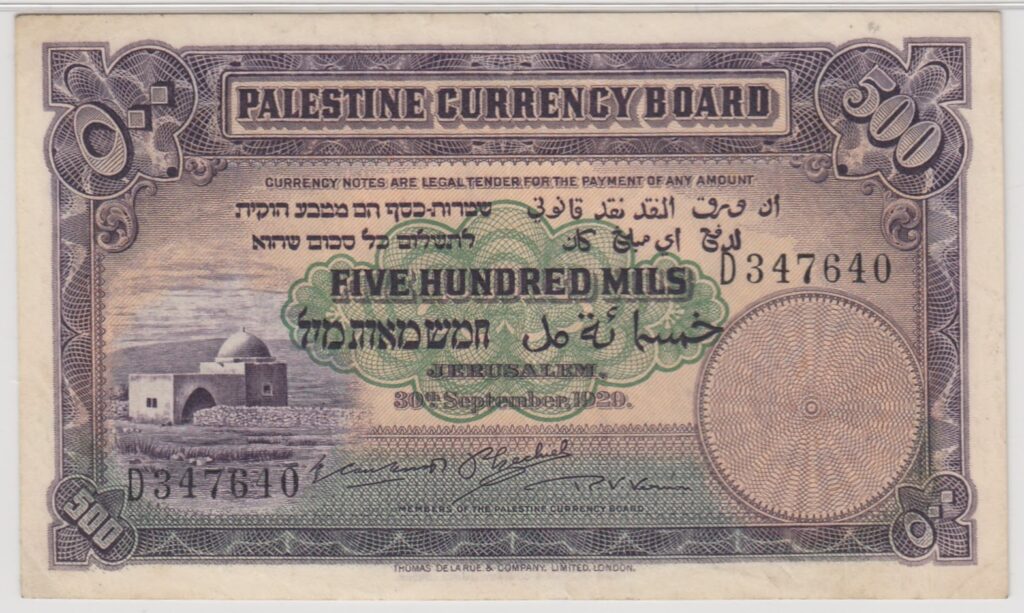
1. Five Hundred Mils — Palestine Currency Board, 1929 & 1945
The 500 Mils note is the only denomination in the Palestine Currency Board series to carry the vignette of Rachel’s Tomb — Qubbat Rakhil in Arabic, Qever Rahel in Hebrew — the domed shrine at the northern entrance to Bethlehem on the Hebron Road.
Rachel, the second wife of the patriarch Jacob, is venerated across Judaism, Christianity and Islam, and the domed structure depicted on the note — an Ottoman-era building renovated in 1841 — was a site of shared pilgrimage for all three faiths. Its selection for the lowest paper denomination was, like every design decision on these notes, the product of intense negotiation between communities, faiths and competing political visions for the land.
The reverse carries the Citadel and Tower of David — Burj Daud in Arabic, Migdal David in Hebrew — the ancient symbol of Jerusalem that stands beside the Jaffa Gate at the entrance to the Old City, a landmark as familiar to Palestinian Christians and Muslims as to Jewish pilgrims.
This second issue, dated 1929, was among the earliest Palestine Currency Board notes to enter circulation — passing through Palestinian hands at a moment when the Mandate was still new, its promises still unresolved, and the land’s future still unwritten.
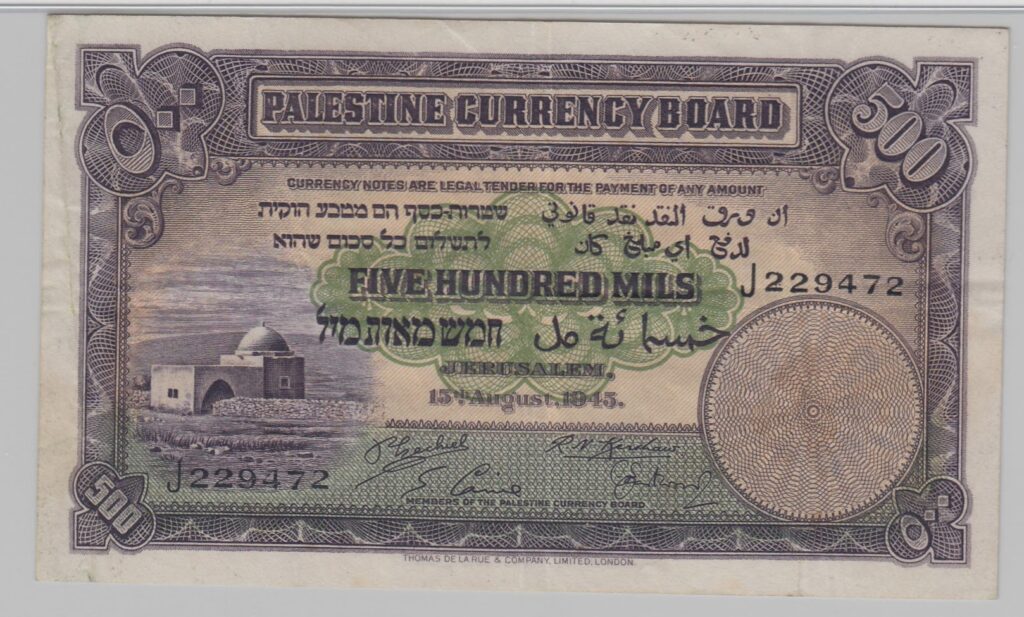
15 August 1945. The day Japan surrendered and the Second World War ended.
This final issue of the 500 Mils note was dated on the last day of the deadliest conflict in human history — yet in Palestine, the ending of one crisis only sharpened the edges of another. Waves of Jewish survivors from the Holocaust were pressing to enter, Arab Palestinians were bracing for the political storm they could see approaching, and Britain was running out of time and will to hold its Mandate together.
Yet this small purple note, carrying the same image of Rachel’s Tomb that had appeared on every 500 Mils since 1927, passed through Palestinian hands as it always had — in markets, at bakeries, across shop counters from Haifa to Hebron.
Bearing four signatures of the Palestine Currency Board members, it is the most complex signatory arrangement of any note in the collection — a quiet reflection of the wartime expansion of the Board’s membership as Palestine’s administration grew ever more complicated.
The 500 Mils carries the legal tender declaration in all three languages — English, Arabic and Hebrew — as do all Palestine Currency Board denominations. However it is the only denomination that does not carry the Hebrew abbreviation א״י — Eretz Israel, the Land of Israel. The £1, £5, £10 and £50 pound notes all designate the currency as פונט פלשתינאי (א״י): the Palestine Pound of Eretz Israel — a political claim embedded by British authority into the face of every pound note ever issued, inscribed into the paper money passing through Palestinian hands across two decades of Mandatory rule.
2. One Palestine Pound — Palestine Currency Board, 1927 & 1944
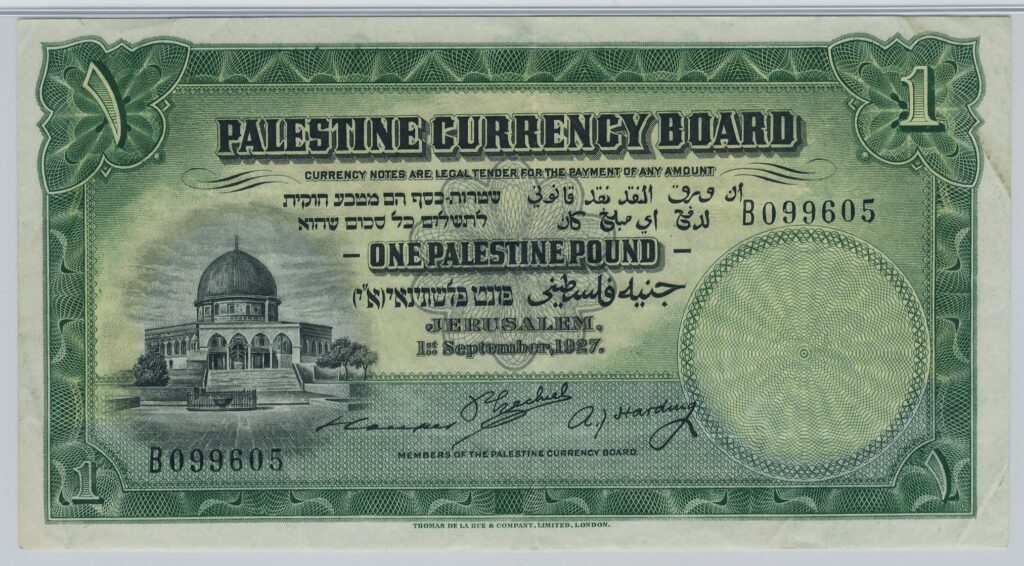
The first issue of the Palestine Pound, dated 1 September 1927 — just weeks before the notes entered circulation on 1 November. This early-dated example announced something historic: Palestine had its own currency at last.
The central vignette shows the Dome of the Rock — Qubbat al-Sakhra in Arabic — rising above the platform of al-Haram al-Sharif, the Noble Sanctuary, in Jerusalem. Islam’s third holiest site, built in 691 CE by the Umayyad Caliph Abd al-Malik, the Dome stands over the sacred rock from which, according to Islamic tradition, the Prophet Muhammad ascended to heaven. For Jews it marks the Foundation Stone, the holiest point on earth.
That this image — arguably the most contested few square metres on the planet — should appear on the face of Palestine’s first currency was a choice of extraordinary weight. Every design decision on these notes carried political meaning; this one carried the weight of centuries.
The reverse, shared across all denominations, shows the Citadel and Tower of David beside the Jaffa Gate. Printed in deep green, the £1 note is considered the most beautifully designed in the entire PCB series.
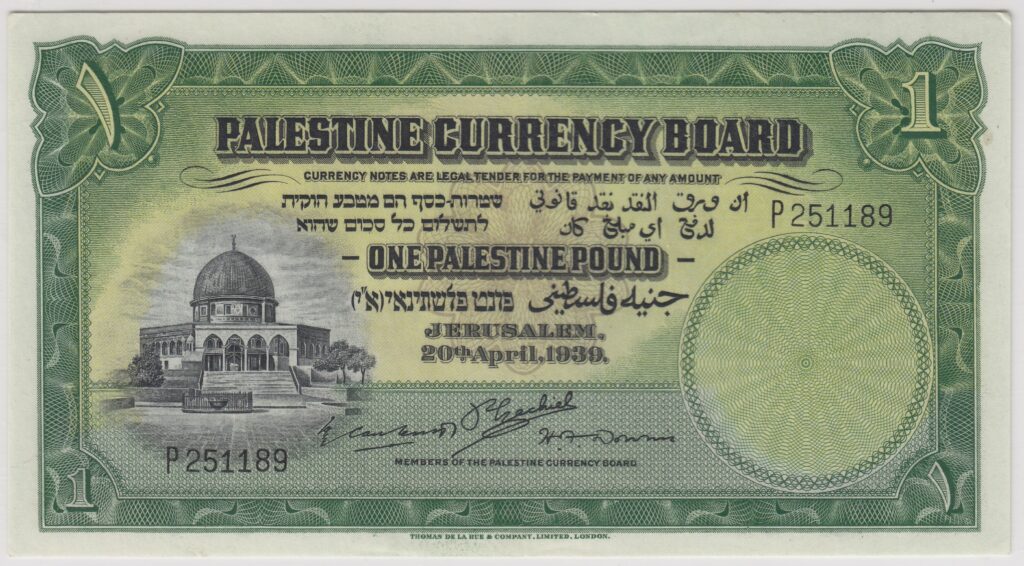
A Palestine Pound dated 20 April 1939 — issued in the last months of peace, in a country already exhausted by three years of revolt.
By the spring of 1939 the Arab Revolt, which had convulsed Palestine since 1936, was grinding to its close under the weight of British military suppression. Within weeks of this note’s date, on 17 May, Britain would publish the White Paper that sharply restricted Jewish immigration and land purchase — and by September the country would be at war, its ports and cities turned over to the Allied effort.
The Dome of the Rock vignette — unchanged since the first 1927 issue — still dominates the face of the note, a constant image of Jerusalem across more than a decade of extraordinary history. Through depression, revolt and the approach of world war, that dome remained at the centre of Palestine’s currency, unchanged and unchanging.
Bearing the signature of Sir Percy Ezechiel alongside his fellow Board members, and printed by Thomas de la Rue of London, this note passed through Palestinian hands at the precise hinge of the Mandate — after the revolt, before the war, and less than a decade before the country it names would cease to exist.
The trilingual text across the face of the note carries its own quiet political weight. In English: Currency Notes are Legal Tender for the Payment of Any Amount. In Arabic: the same statement, straightforward and unadorned. In Hebrew — and here the politics become visible — the Palestine Pound is designated פונט פלשתינאי (א״י): the Palestine Pound of Eretz Israel, the Land of Israel.
That abbreviation — א״י, Eretz Israel — was not a neutral geographic term. It was the Hebrew name for the land that the Zionist movement had claimed as its national homeland, embedded by British authority into the face of every Palestine Pound ever issued, in every market and every transaction across the country. Three languages, one currency, and already — in 1927 — a contest over the name of the land itself written into the paper money in Palestinian hands.
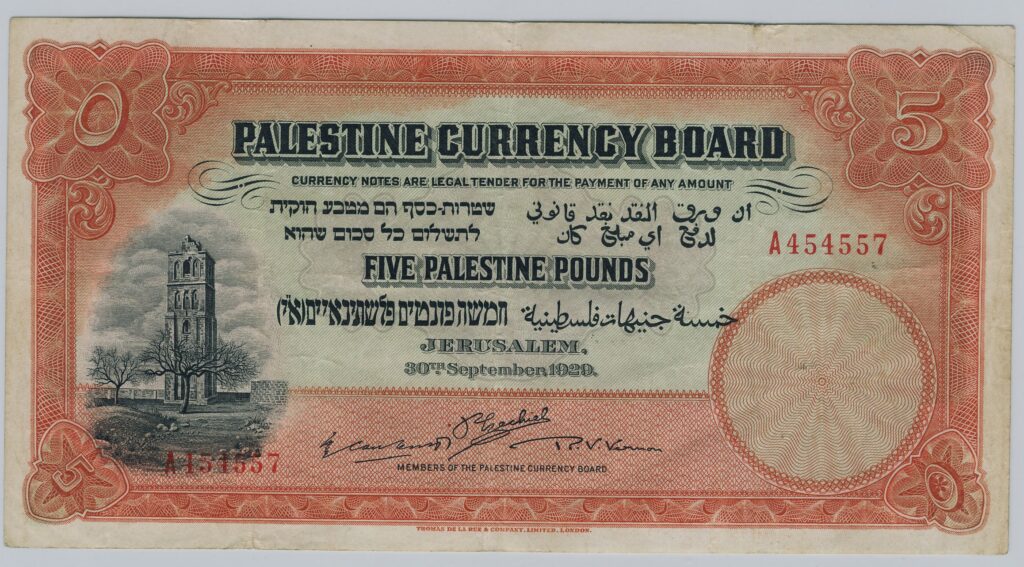
3. Five Palestine Pounds — Palestine Currency Board, 1929
The £5 note introduces the second great vignette of the Palestine Currency Board series: the White Tower of Ramla — Burj al-Abyad in Arabic — a 13th-century Mamluk minaret built by Sultan al-Zahir Baybars in 1268 to celebrate his eviction of the Crusaders from Ramla and to serve the ancient White Mosque of Caliph Suleiman.
Known to Muslims as the Tower of the Forty Companions of the Prophet, and to Christians as the Tower of the Forty Martyrs, it is a monument that carries the resonances of centuries of Palestinian history within its 30-metre stone walls.
Al-Ramla — whose name means “the sands” in Arabic — is the only town in the region founded by Arabs, established in the early 8th century as the first capital of Arab Palestine. That it should appear on the face of the £5 Palestine Pound is a quiet but powerful acknowledgement of Arab Palestine’s ancient urban roots.
Printed in red on cream and bearing the signatures of Ezechiel, Caulutt and Vernon, this 1929 second issue represents one of the earliest £5 notes to enter circulation in Mandatory Palestine.
4. Ten Palestine Pounds — Palestine Currency Board, 1939
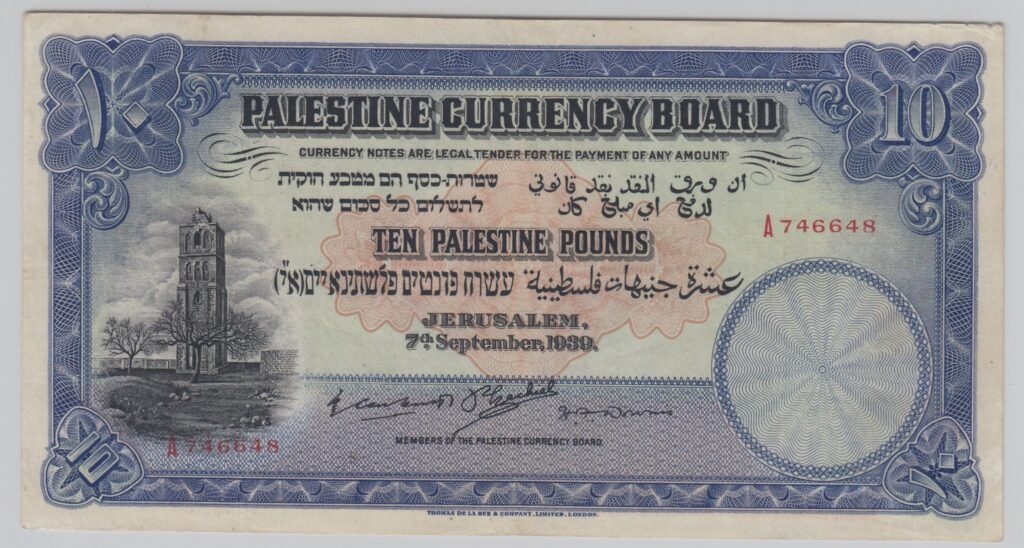
Dated 7 September 1939 — six days after Germany invaded Poland and Britain declared war — this £10 note arrived in Palestine as the world changed forever.
The Tower of Ramla vignette, shared with the £5, dominates the face of the note in deep blue — the ancient 13th-century minaret standing above a bare winter tree and a flock of sheep, a pastoral Palestinian landscape rendered in extraordinary engraving detail by Thomas de la Rue.
At £10, this was a note of substantial value — weeks of wages for most Palestinian workers — yet it circulated through a Palestine that was itself about to be transformed. Within months the country would become a major Allied base, its ports and cities filling with troops, its workers drawn into wartime industries, its political future increasingly contested.
The date alone makes this note a document of history in the fullest sense: a piece of Palestinian currency issued on the day the world went to war, in a land that would be unrecognisable before that war ended.
As with all Palestine Currency Board pound denominations, the note carries the legal tender declaration in three languages — English, Arabic and Hebrew — with the Hebrew designating the currency as פונט פלשתינאי (א״י): the Palestine Pound of Eretz Israel, the Land of Israel. A political claim, quietly embedded into every pound note that passed through Palestinian hands.
1948 — The End of the Palestine Pound
The Palestine pound remained in circulation until the end of the British Mandate in May 1948. When the Mandate ended, the Palestine Currency Board was wound up. In the territory that became Israel, the Palestine pound was replaced by the Israeli pound. In the West Bank and Gaza, Jordanian and Egyptian currencies respectively took over. The Palestine pound — a currency that had served the people of Palestine for two decades — ceased to exist. The notes that remained became artefacts overnight, silent witnesses to a country whose name they still carry.
The notes that remained became artefacts overnight, silent witnesses to a country whose name they still carry.