Francis Frith (1822–1898) was among the first photographers to systematically document Palestine. Born in Chesterfield, Derbyshire, he sold his prosperous business in 1855 to dedicate himself entirely to photography, making three celebrated expeditions to the Middle East between 1856 and 1860.
Travelling with large-format glass plate cameras through terrain that challenged even unencumbered travellers, Frith captured Palestine at a pivotal moment — before modernisation changed its ancient landscapes forever. His images were published in books and distributed as prints across Britain and Europe, giving Western audiences their first photographic encounter with the Holy Land.
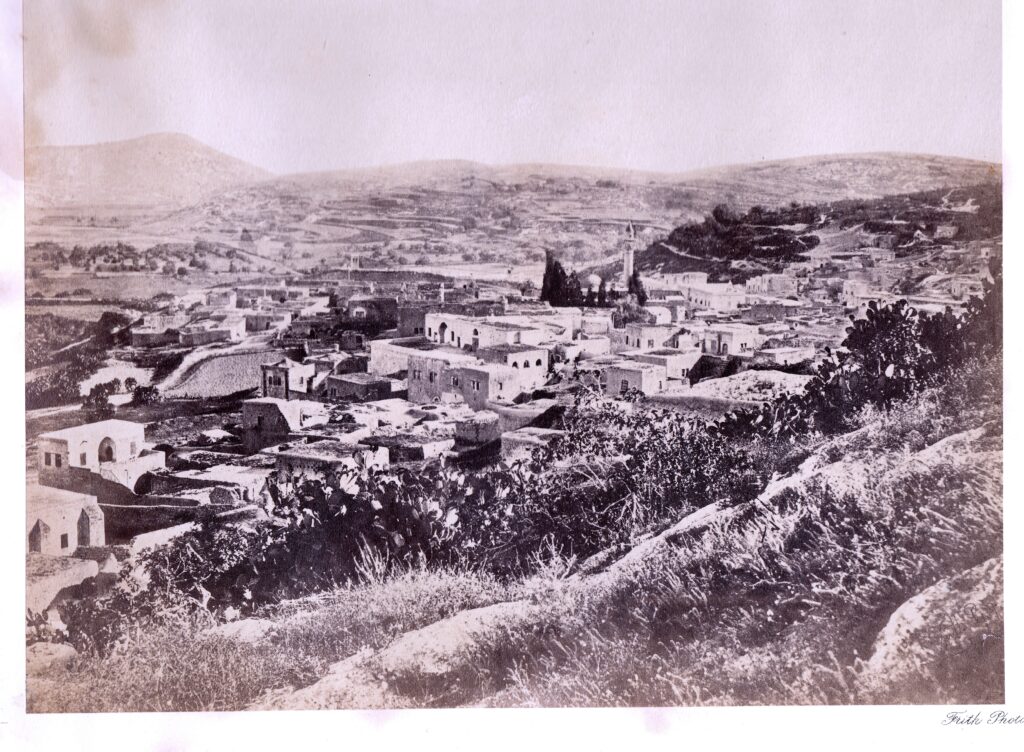
Nazareth from the North
This panoramic view of Nazareth was captured during Frith’s celebrated expeditions to the Holy Land. At the time this photograph was taken, Nazareth was a modest town of perhaps 4,000 inhabitants — Muslims, Christians and Jews living alongside one another in the terraced stone houses visible across the hillside.
The minaret rising above the rooftops belongs to the White Mosque, one of the town’s oldest Islamic landmarks, while the dome nearby marks one of the many Christian churches that gave Nazareth its significance as a pilgrimage destination.
The rocky foreground with its wild cactus and scrub vegetation is characteristic of the Galilean landscape — terrain that had changed little in centuries. The rolling hills in the background show the agricultural terracing that Palestinian farmers had maintained for generations, cultivating olives, vines and grain on land their families had worked for hundreds of years.