
PALESTINE IN HISTORY · THE COLLECTION
A Chance Discovery
The Story Behind the Collection
Christchurch, New Zealand · 2006
It began, as many of the best things do, entirely by chance — and without any grand intention. In 2006, a Palestinian-Australian was visiting a New Zealand friend on the South Island when the two of them set out one day to explore Christchurch. It was an unhurried kind of day, the best kind, with no particular destination in mind.
Christchurch, as it happens, is not an innocent backdrop to a Palestinian story. New Zealand sent thousands of its sons to fight in the Sinai and Palestine Campaign of 1917 and 1918, part of the Allied force under General Allenby that swept through a land that had been Ottoman for four centuries. The New Zealand Expeditionary Force crossed the Jordan, rode into Jerusalem, and left its mark on Palestine — just as Palestine left its mark on New Zealand. In Christchurch, cenotaphs and war memorials carry the name Palestine among their inscriptions, quiet stone records of young men who travelled to the other side of the world to march through ancient streets. The connection between these two distant places is older than most people realise.
It was in this city, on this particular day, that he found himself wandering alone into an antique shop. And there, unexpectedly, was Palestine — a small gathering of objects that had somehow made the same journey in reverse: coins worn smooth by the hands that had spent them in Palestinian markets, stamps that had carried letters across a land in transition, postcards bearing photographs of streets and markets and holy places instantly recognisable to a man whose family came from that land. How these objects found their way to a shop in Christchurch is a question without a clean answer — perhaps carried home by a soldier, a traveller, a missionary, or simply passed from hand to hand across a century until they came to rest here, waiting. He bought them, returned to his friend, and shared what he had found — still surprised by it himself.
He bought them without hesitation, tucked them into his bag, and carried them home to Australia. He bought them not as a collector, but as someone simply trying to understand his own history a little better — to hold in his hands something that had once been held in Palestine. What started that afternoon as a quiet personal hobby gradually revealed itself to be something more: an archive in the making, assembled one object at a time, across two decades, across three continents.
A Palestinian finding pieces of Palestine in a city that sent soldiers to Palestine, beside memorials that record their arrival there. History, it seems, has a way of folding back on itself.
Artefacts from the Archive
Each piece below is a quiet witness to a history that belongs not to the winners of wars, but to the people who lived, worked, prayed and loved in one of the most remarkable places on earth.
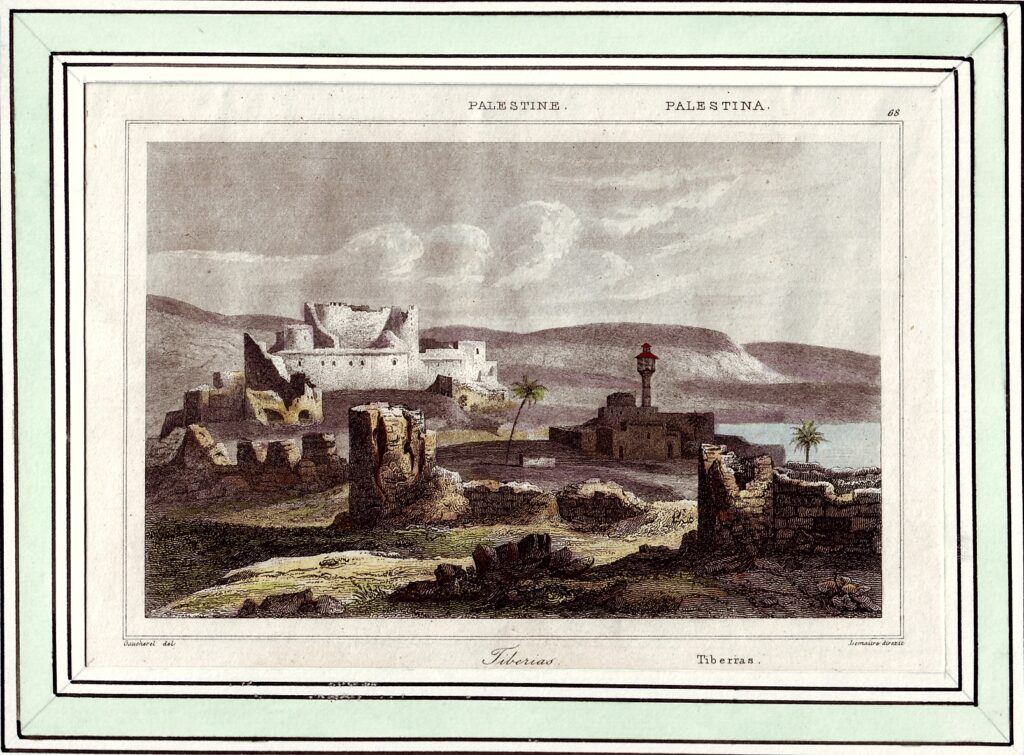
Tiberias — Palestine & Palestina
ENGRAVING · EARLY 19TH CENTURY
A hand-coloured steel engraving of Tiberias, on the western shore of the Sea of Galilee, drawn by Bouchard and engraved by Lemaitre. Published as plate 68 in a French geographical atlas, this image shows the ancient citadel rising above the ruins of the old city walls, with the distinctive calm of the lake stretching into the distance.
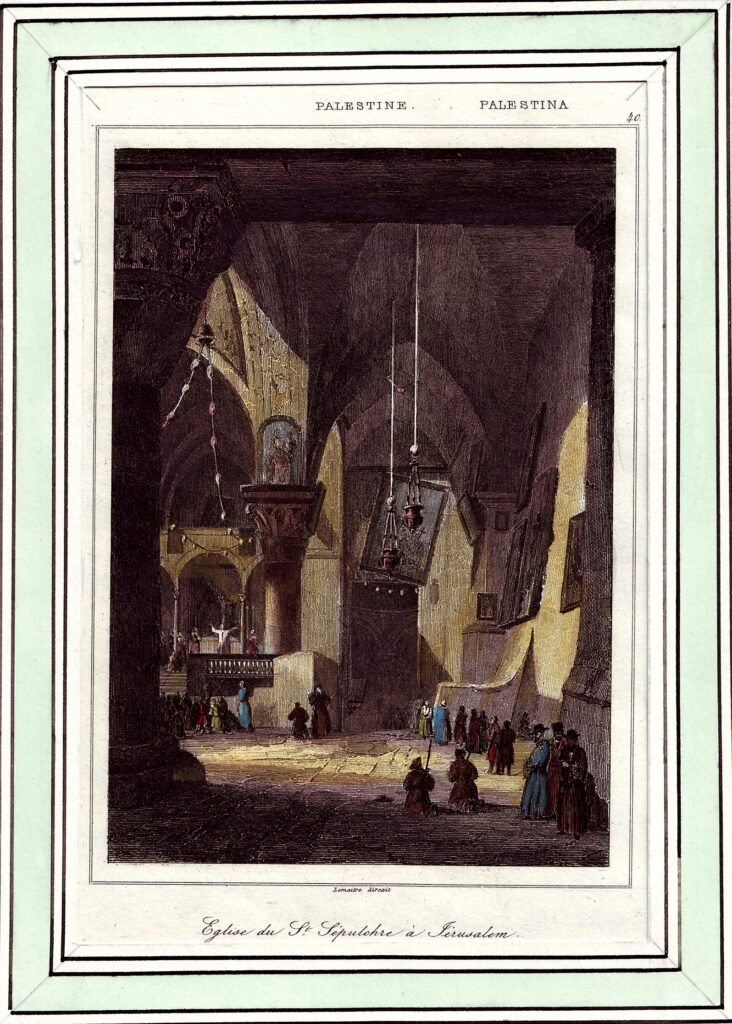
Église du St. Sépulchre à Jérusalem
ENGRAVING · EARLY 19TH CENTURY
The interior of the Church of the Holy Sepulchre in Jerusalem, one of the most sacred sites in Christendom, rendered in rich hand-applied colour. Figures in period dress move through the vast candlelit nave beneath hanging lanterns, while shafts of light illuminate the carved stonework. Engraved by Lemaitre, plate 40 of the same French series.
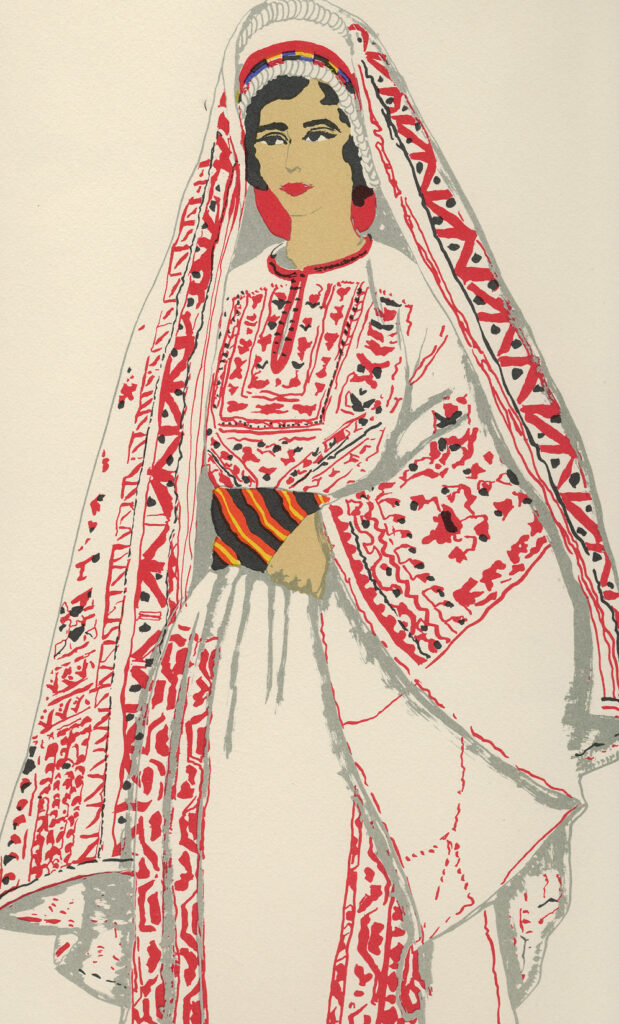
Palestinian Woman in Traditional Dress
ENGRAVING · EARLY 19TH CENTURY
A fine art print depicting a Palestinian woman in full traditional dress, her garments richly embroidered with tatreez — the centuries-old Palestinian needlework tradition in which patterns of red and black on white linen encode village identity, marital status and cultural heritage. The boldness of the red embroidery against the white cloth is characteristic of the distinctive style of the central Palestinian highlands.
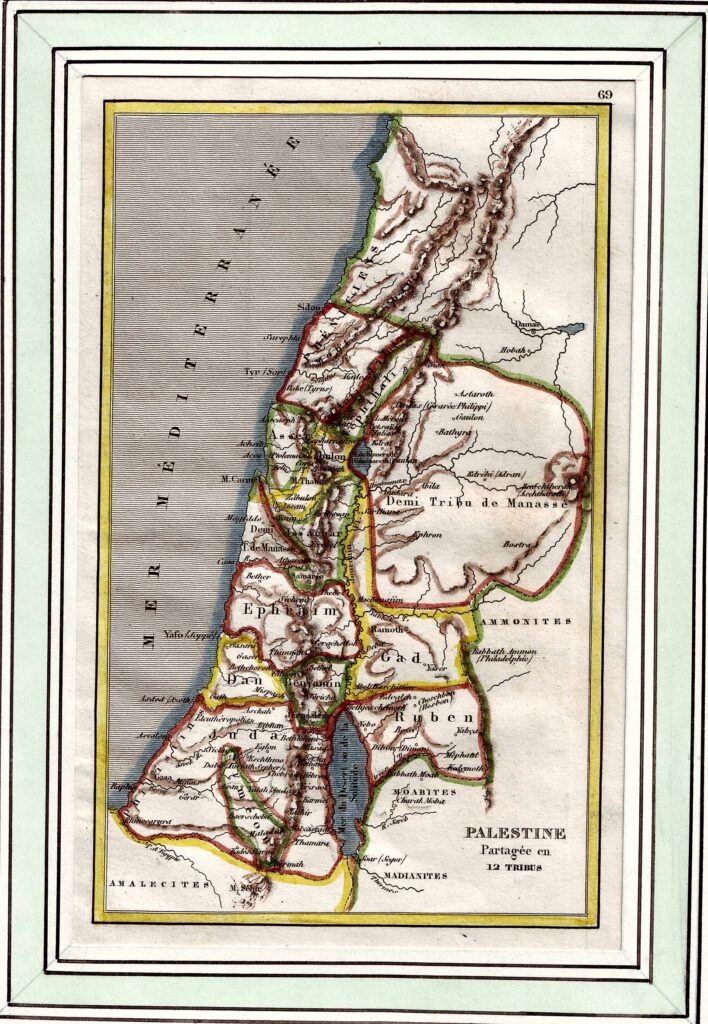
Palestine Partagée en 12 Tribus
ENGRAVING · EARLY 19TH CENTURY
A hand-coloured map of Palestine as divided among the Twelve Tribes of Israel, labelled in French with place names drawn from both biblical and contemporary geography. The Mediterranean coastline runs the length of the left edge; the tribal boundaries are rendered in delicate washes of colour. Plate 69 of the same French atlas series — a remarkable cartographic artefact from the same volume as the Tiberias and Holy Sepulchre engravings.
Palestine · 10 Mils · 1947
NUMISMATICS · BRITISH MANDATE PERIOD
A British Mandate-era Palestine 10 Mils coin, minted in 1947 — just one year before the end of the Mandate period. The coin bears the word Palestine in three scripts: English, Arabic (فلسطين) and Hebrew (פלשתינה א״י) — a trilingual inscription that makes these coins among the most historically resonant of all Palestinian artefacts. The hole through the centre is the signature design feature of the Palestine Mandate coinage. This is one of the categories of object found in that Christchurch antique shop in 2006 — where the collection began.
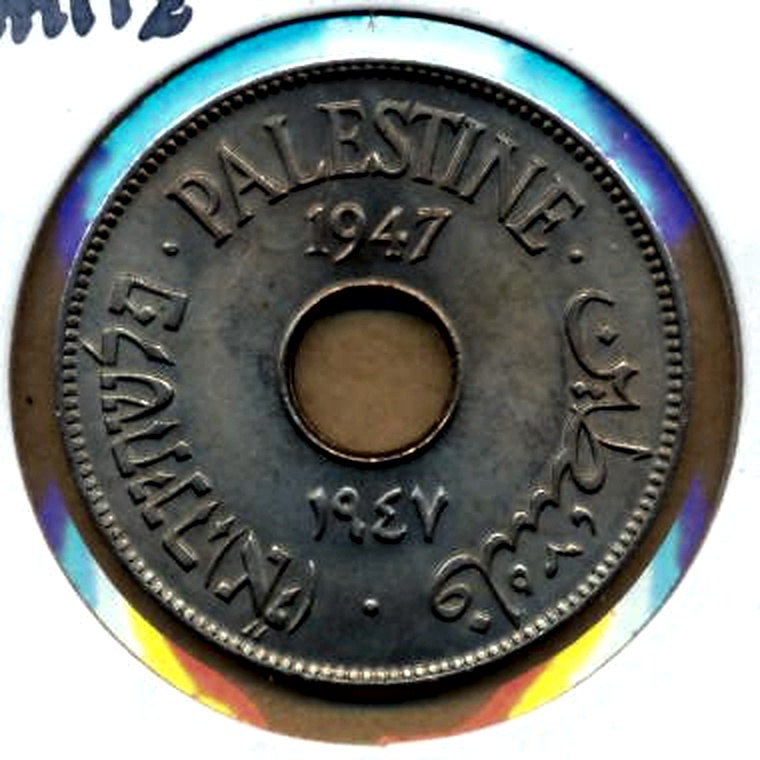
10 Mils · 1947 · British Mandate for Palestine · Palestine Currency Board
The collection has grown considerably since that afternoon in Christchurch — through antique shops, through specialist auction houses including Spink in London and Heritage Auctions and Stack’s & Bowers in the United States, and through two decades of patient, purposeful searching. But every piece in the archive carries something of the spirit of that first discovery: the quiet surprise of finding Palestine somewhere unexpected, and the impulse to pick it up, carry it home, and ask what it has to say.