The Ottoman Empire introduced paper money to Palestine in the 1860s, representing one of the most significant economic developments in the region’s modern history. Known as “Kaime,” these early notes were issued by the Ottoman Imperial Treasury and circulated across the vast empire including Palestine.
Ottoman paper currency went through several distinct phases. The earliest notes from the 1860s were rudimentary by modern standards — hand-signed, simply printed and backed by the empire’s treasury. Over the following decades they became more sophisticated, reflecting the empire’s attempts to modernise its financial system and compete with European banking institutions.
For Palestinians, Ottoman banknotes were the currency of everyday life — used in the markets of Jerusalem, Jaffa, Hebron and Nablus for generations. They represent a tangible connection to the Ottoman period of Palestinian history, a period that shaped the region’s culture, architecture and social fabric in ways that are still visible today.
The collapse of the Ottoman Empire following the First World War brought this era of currency to an end. British forces entered Jerusalem in 1917, and by 1918 Ottoman administration of Palestine was effectively over. The banknotes that remained became historical artefacts overnight — silent witnesses to an empire’s end and a new chapter in Palestine’s story
The Collection — Ottoman Banknotes in Palestine
The following banknotes from the collection span the full arc of Ottoman currency in Palestine — from the earliest Kaime notes of the 1870s through to the final issues of the First World War era. Each note is a tangible piece of Palestinian economic history, handled by merchants, farmers and families across Jerusalem, Jaffa, Hebron and Nablus.
1. Banque Impériale Ottomane — 5 Kurush, 1877
One of the earliest Ottoman banknotes in the collection. The Kaime notes of the 1870s were among the first paper currency to circulate in Palestine, issued by the Banque Impériale Ottomane — a joint Ottoman-European institution established in Constantinople in 1863.
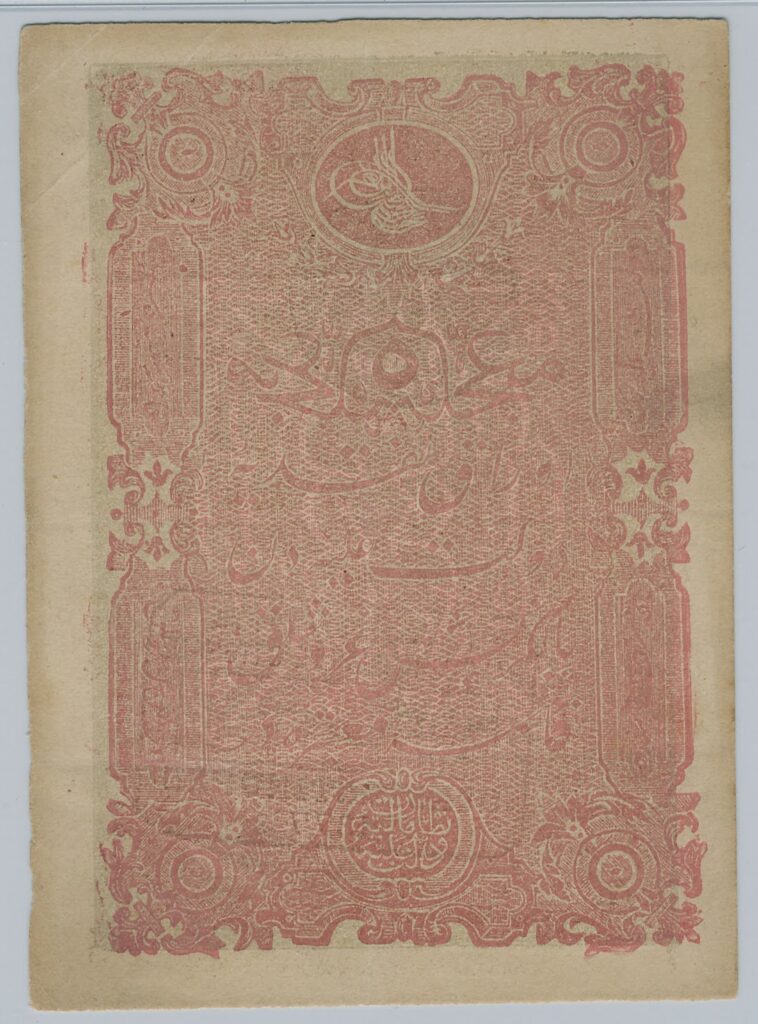
2. Banque Impériale Ottomane — 100 Kurush, 1877–78
A high denomination Kaime note featuring the imperial tughra at centre — the ornate monogram of the Ottoman Sultan. The AH1294 handstamp confirms its date of issue. These large denomination notes were used for significant commercial transactions across the empire including Palestine.

3. Banque Impériale Ottomane — ¼ Livre, 1915–16
A rare small denomination from the First World War era — printed on one side only (unifaced). By 1915 the Ottoman Empire was under enormous financial strain from the war, and small denomination notes like this ¼ Livre

4. Banque Impériale Ottomane — 1 Livre, 1916–17
A beautifully preserved example of the standard 1 Livre note circulating in Palestine during the final years of Ottoman rule. The intricate green guilloché pattern and elegant Arabic calligraphy reflect the sophistication of Ottoman banknote design at its peak..

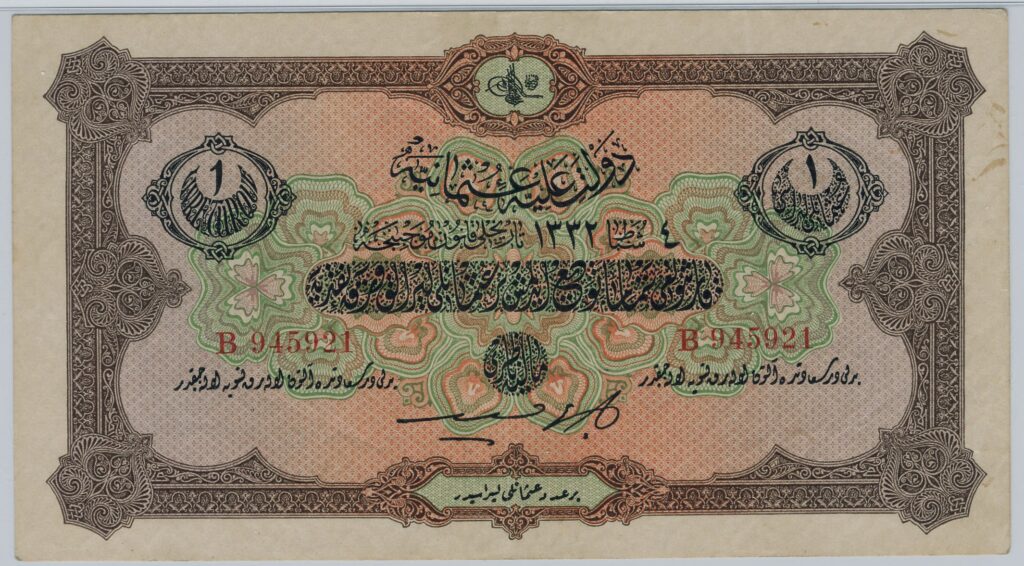
5. Banque Impériale Ottomane — 1 Livre, 1916–17
A second variant of the 1 Livre — note the warmer colour palette compared to Pick#90a. The imperial tughra appears at the top centre, with the denomination in both Arabic numerals and Ottoman script. This note would have been in active circulation in Palestinian markets through 1917.
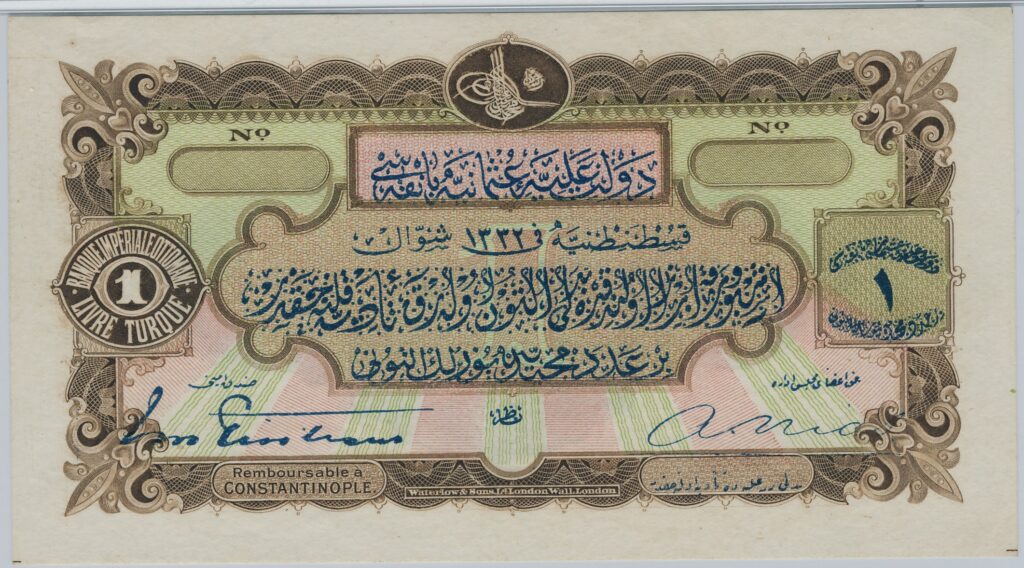
6. Banque Impériale Ottomane — 1 Livre Remainder, 1916–17
An extraordinary piece — an unissued remainder note, printed by Waterlow & Sons of London Wall, London. Remainders were notes printed but never officially issued or signed. The PMG grade of 64 reflects its perfect uncirculated condition — a note that never passed through Palestinian hands, yet tells the story of an empire printing currency in its final years.
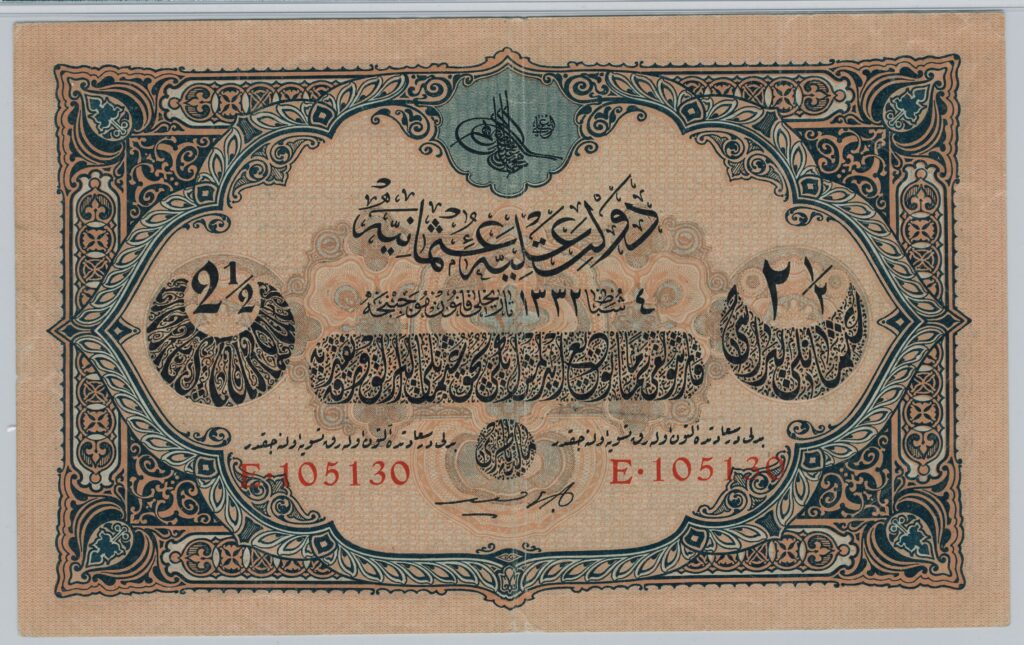
7. Banque Impériale Ottomane — 2½ Livres, 1916–17
One of the rarest Ottoman denominations — the 2½ Livre note is seldom encountered. Its salmon-pink and teal design is among the most striking of all Ottoman banknotes. This note circulated in Palestine in the final months of Ottoman rule before British forces entered Jerusalem in December 1917.
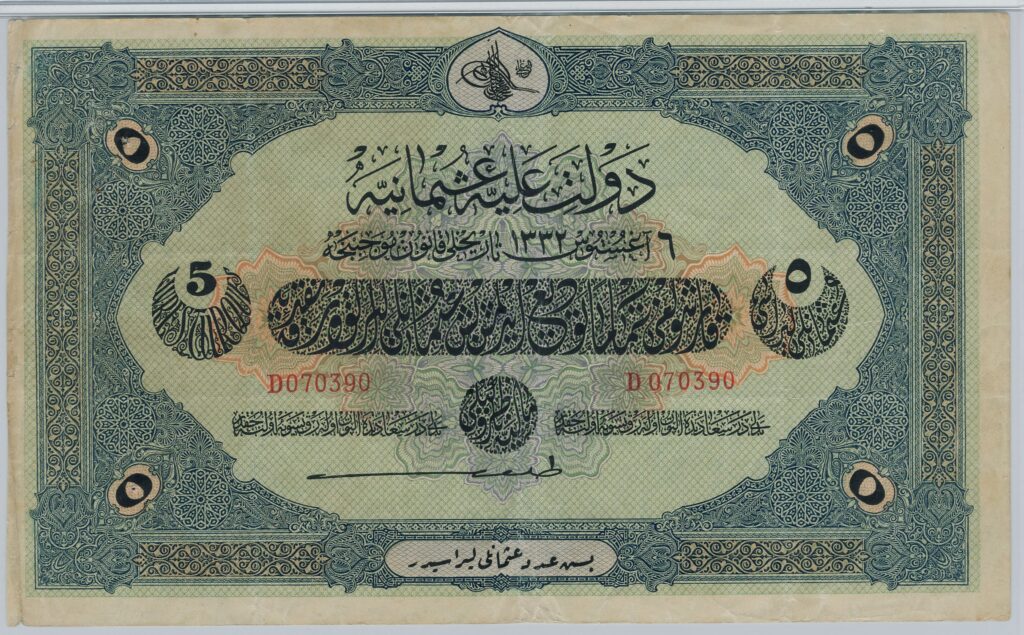
8. Banque Impériale Ottomane — 5 Livres, 1916–17
The highest denomination in the collection from this era. A 5 Livre note represented significant value — roughly equivalent to several weeks’ wages for a Palestinian labourer. The bold geometric design and large Arabic numerals at each corner make this one of the most visually striking notes of the period.