
For a decade that is largely forgotten in the history of Palestinian currency, the Egyptian pound was the official money of Mandatory Palestine. When British forces entered Jerusalem in December 1917 and the Ottoman financial system collapsed overnight, Britain turned to its Egyptian administration for a rapid solution — introducing Egyptian currency as the legal tender of the new Mandatory territory.
Why Egypt?
The choice of the Egyptian pound was entirely practical. Egypt had been under British administration since 1882 and already operated a stable, sterling-linked currency system. Introducing Egyptian notes and coins to Palestine required no new infrastructure, no new printing contracts and no new legislation — it was the fastest path to economic stability in a territory emerging from four centuries of Ottoman rule and the chaos of the First World War.
A Decade of Egyptian Currency in Palestinian Markets
From 1917 to 1927, Egyptian banknotes passed through the hands of Palestinian merchants in the markets of Jerusalem, Jaffa, Haifa and Nablus. The Egyptian pound — known in Arabic as الجنيه المصري (al-junaih al-masri) — was pegged to sterling at one pound to one pound, providing the price stability the economy desperately needed. Palestinian farmers, tradespeople and families conducted their daily commerce in a currency that bore no reference to Palestine whatsoever — a currency of convenience in a land whose own identity was being actively debated by the great powers.
The Transition to the Palestine Pound
The creation of the Palestine Currency Board in 1927 and the introduction of the Palestine Pound brought the Egyptian chapter to a close. Egyptian notes were gradually withdrawn from circulation and exchanged at par — one Egypt pound for one Palestine pound. By the early 1930s Egyptian currency had largely disappeared from Palestinian commerce, replaced by the distinctively designed Palestine Pound that would serve as the territory’s currency until 1948.
The Collection - Egypt Banknotes in Palestine
The collection includes rare examples of Egyptian pound banknotes that circulated in Palestine during this transitional decade — tangible evidence of a chapter in Palestinian economic history that few history books record. Each note is a quiet witness to a period of profound uncertainty and change in the life of Palestine and its people.
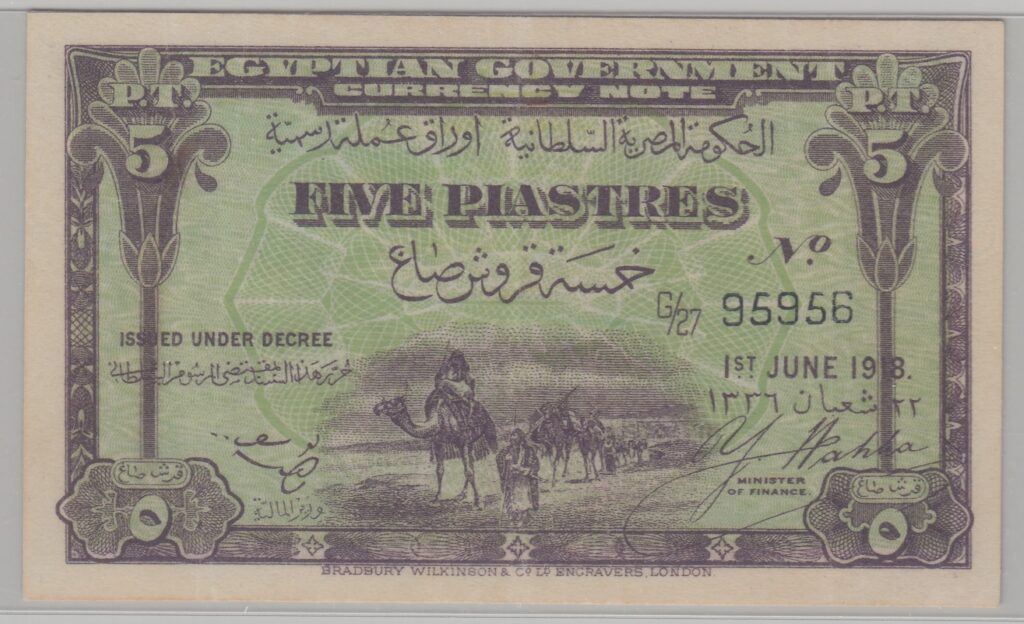
1. Egyptian Government Currency, 5 Piastres
The most intimate note in the collection — a Five Piastres Egyptian Government Currency Note from 1918, signed by Yusuf Wahba, Egypt’s Minister of Finance. Unlike the larger National Bank of Egypt notes, this was issued directly by the Egyptian Government rather than the bank, part of a wartime emergency currency series introduced to keep small transactions moving across Egypt and Mandatory Palestine. The green and purple note depicts a camel caravan crossing open desert — a scene that would have resonated equally in Cairo or in the markets of Jaffa. Printed by Bradbury, Wilkinson & Co. of London, the same firm that printed banknotes for the Ottoman Empire and would later print the Palestine Currency Board notes that replaced it.
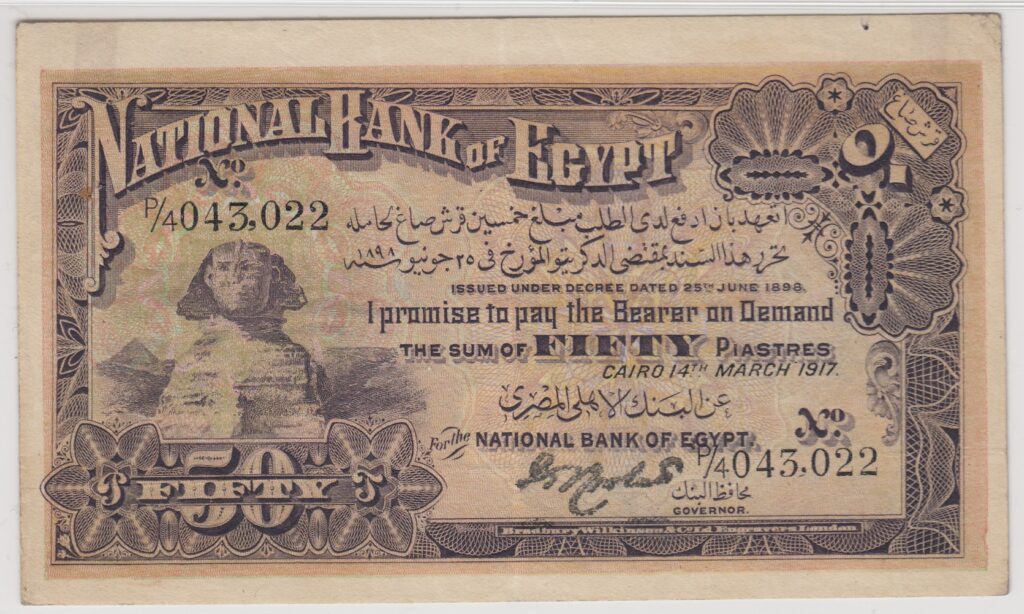
2. National Bank of Egypt, 50 Piastres
Dated just days after British forces were consolidating their control over Palestine, this 50 Piastres note carries one of the most recognisable symbols of Egypt — the Great Sphinx of Giza — at the centre of its design, with a mosque minaret rising to the left. The Sphinx had appeared on National Bank of Egypt notes since the very first issue in 1899, a conscious choice to anchor Egyptian currency in the country’s ancient identity at the very moment Britain was remaking the region. At one hundred piastres to the Egyptian pound, this was a note of moderate everyday value — the kind exchanged across shop counters, in souks and market stalls in Palestinian towns and villages throughout the transitional decade.
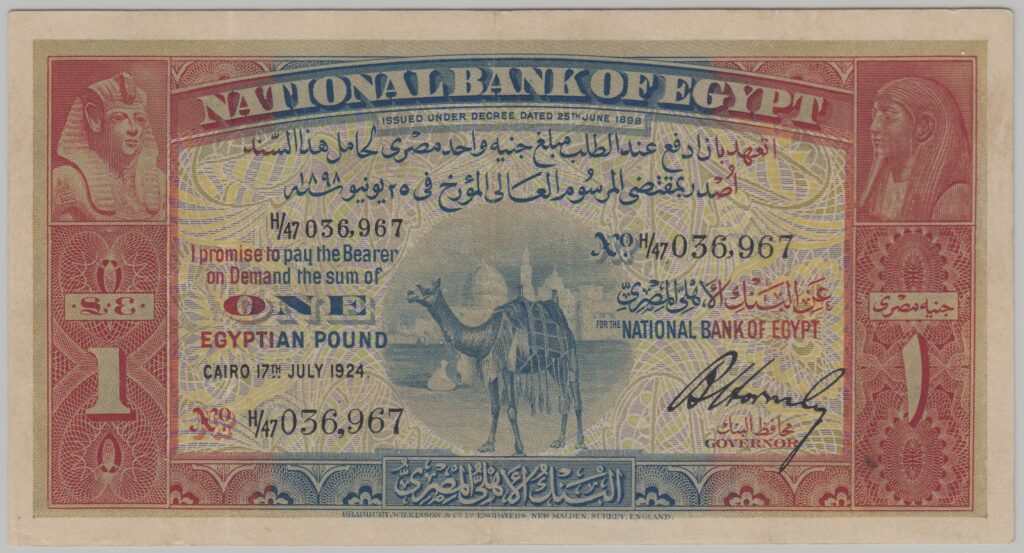
3. National Bank of Egypt, 1 Pound
The £1 note was the workhorse of daily Palestinian commerce during the transitional decade. This beautifully preserved 1924 example carries what became one of the most distinctive designs in the entire National Bank of Egypt series — a large camel and rider in the central vignette, the animal’s head turned toward the viewer, flanked by Pharaonic portrait figures and rich red guilloche patterning. The £1 note was the workhorse of Palestinian daily commerce during the transitional decade — the note most likely to change hands in a Jaffa market, a Jerusalem shop or a Nablus souk.
4. National Bank of Egypt, 5 Pounds
This striking £5 note was issued just three years before the Egyptian pound was replaced in Palestine by the Palestine Currency Board notes. The design is anchored by the grand neoclassical facade of the National Bank of Egypt’s own headquarters in Cairo — a building that was, at the time of issue, one of the most imposing financial institutions in the Middle East. Interestingly, PMG classifies this note under “Egypt / Ottoman Administration” — a reminder of the complex and overlapping layers of authority that still characterised the region even years into British rule.

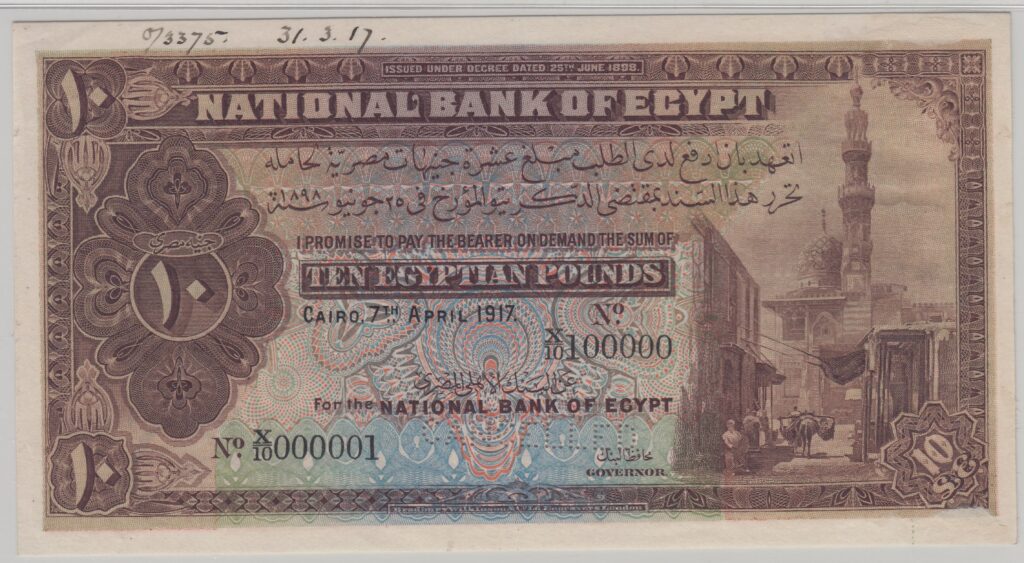
5. National Bank of Egypt, 10 Pounds
Dated 7th April 1917 — the very first weeks of Britain’s military administration of Palestine — this £10 note carries the serial number X/10 000001, the first of its print series. A document from the opening chapter of a new era.
The central vignette shows a scene from Old Cairo: the street and mosque of Sultan Qaytbay, the 15th-century Mamluk ruler whose funerary complex in Cairo’s Northern Cemetery is considered one of the finest examples of Mamluk architecture ever built. That a scene of medieval Islamic Cairo should serve as the face of currency circulating in medieval Islamic Palestine speaks to the strange coherence — and the deep strangeness — of Britain’s dual administration of these two Arab lands.
The pencilled notation in the upper margin — “073375 — 31.3.17” — is a printer’s reference from Bradbury, Wilkinson & Co., an archival mark recording the very note type that would pass through Palestinian hands for the decade that followed.
6. National Bank of Egypt, 50 Pounds
The crown of the collection — a magnificent £50 note issued just two years after British forces entered Palestine.
The central vignette depicts a group of domed tombs and minarets rising from the Cairo landscape, a camel caravan moving across the foreground — drawn from the Mamluk tomb complexes of Cairo’s City of the Dead, one of the great monuments of Islamic architecture. That this image of Cairo’s sacred landscape should serve as the face of currency in Palestine’s markets speaks once again to the quiet but profound connections Britain forged between these two Arab lands under its administration.
At £50, this was a note of exceptional value — the equivalent of months of wages for most Palestinian workers in 1919, yet it was the official currency of the land, as valid in a Jerusalem souk as in a Cairo bank.
The note bears the signature of Sir Frederick Rowlatt, Governor of the National Bank of Egypt from 1902 to 1924 — the single figure whose name crossed the entire transitional decade, on Egyptian notes that circulated from Cairo to Jerusalem, from Alexandria to Jaffa, until the Palestine Currency Board brought this chapter to a close in 1927.

These six notes represent a decade of Palestinian monetary life that has been almost entirely forgotten. No Palestinian currency board, no distinct Palestinian notes — just Egyptian pounds passing through Palestinian hands, in Palestinian markets, in a land being remade by forces far beyond its borders. Each note in this collection is a quiet witness to that forgotten chapter.